
Hi there!!
Today I’m going to introduce the
assessment part of the course I’ve been presenting you these days, which would
be related to short stories teaching. In order to carry out the assessment, we have to choose 2 short stories and design some
activities by ourselves that can be directed to the pre-, actual or
post-teaching part of the task.
The first short story I’ve chosen is “Tattercoats”, a fairy tale that you can find in the collection English Fairy Tales by Flora Annie Steel. I’m going to present some pre-and post-activities for this story which will be intended to 4th
of ESO students. They will have to make groups of 5 people each one in order
to work in a collaborative way through all the pre-teaching part. In this way, they will be able to learn about some English writers, about fairy tales as a literary genre and to get a gist of this short story before reading it. I will try to promote collaborative work within a groupwork; students will have to discuss, comment everything and decide their answers as a group, so they will have to negotiate and come to an agreement.
After that, I will also present some
activities for the post-teaching part. In contrast, these activities will be focused on individual work, in order to increase personal skills and personal responsibility. I will propose the game strategy with the use of an interactive game in which different activities are created around different learning styles, as visual or auditory. For this reason, listening comprehension is also emphasized during the activities, but students will also increase their writing abilities since they will have to write different answers using their own words. What's more, they will learn the different elements of a story in English, and this could be considered as a cross-curricular learning, given that these elements are taught in previous years in mother tongue classes.
On the whole, the PURPOSE is to facilitate
learners’ communicative competence in English through the use of literature. They
will develop linguistic, communicative, personal and social skills, together with the increase
of their digital skills, with the use of digital tools as learning strategies. Other
strategies used are searching for information, clarification of terms or
guessing information.
Pre-Activities
1. “Tattercoats” is an
English fairy tale found in several picture books and in various collections,
so your task here will be to click on each author and tell us in 2 lines the most
important facts about his o her life as an English writer.
-
Margaret Greaves, Tattercoats,
1990
- Flora Annie Steel, Tattercoats, English Fairy Tales, 1918
2. Did you know what a fairy tale is? Could you explain it in your own words now?
3. Do you know the meaning of
the short story’s title? This word has become old-fashioned, could you guess the corresponding word we would use nowadays?
Definition: The term "tattercoats" means more than merely "homeless
people", although all beggars are automatically tattercoats (the original
meaning of the word was "beggar or habitual lying-in-the-street
drunk"). It refers to all "ne'er-do-wells" or undesirables, and
it is also a polite way of referring to what a slightly tipsy, and therefore
loose-tongued.
4. Which is the collections’ hardcover
for each one? Could you design your own hardcover of this short story? you can use the option "make a picture" in the webpage Kerproof.

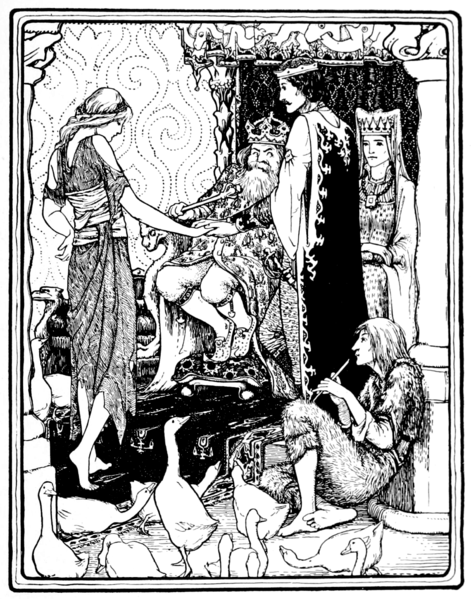

5. Here you have a short
overview of the story, could you guess what is going to happen? Could she finally
go to the ball?
Ragged Tattercoats lived
in the kitchen of her grandfather's castle. She had hardly any friends and no
freedom. Although she loved to dance, she was not allowed to go to the ball.
6. Now that you have already imagined a possible story, you can check if your ideas have been the correct ones with this Tattercoats’ video.
7. Finally, you will have to
create a Glogster using all the information you have already got and it would
be like a way of presenting this short story to other people. Here you have an example of Glogster about the English writer Roald Dahl so, be creative and design your own one!!!
Post-Activities
Extension work: Connections with
Tattercoats: Ciderella

One of the most well-known stories ever
written is Cinderella, a tale that all of you know about. Variations on
Cinderella's myth appear in folktales in almost every world culture: she's
known as "Yeh-Shen" in China, "The Rough-Face Girl" to the
Algonquin Indians of North America, "Chinye" and "Nyasha"
to the people of Africa, "Cenerentola" to Rossini and "Tattercoats" in England.
While these versions vary in some
degree, the general tale usually centers on a kind, but oppressed character
persecuted by the step-family. Typically, the father is either neglectful or
absent; consequently, Cinderella must rely on a magical guardian for assistance
in achieving her deepest wish.
Therefore, working individually on
the English lab, you will establish similarities between these two
fairy tales, but at the same time, you will study the different elements
of a story, all thanks to this interactive game. The answers about the following Tattercoats' questions will be done in a worksheet.
1. The first step would be to
listen again to the story of Ciderella in case you don’t remember it, by
clicking on Cinderella.
2. After that, you will learn
what the setting is in a story, by clicking on setting. Here, you will have to
choose Cinderella’s setting and after that you will write what the Tattercoats’ setting is in the provided worksheet.
3. Now, you will work on the characters. You will have to choose who the characters are in Cinderella’s
story, who the hero is, and who the villain is. After that, you will do the
same in Tattercoats’ worksheet.
5. After that, it is
presented the exposition. You will have to choose Cinderella’s exposition and
create the Tattercoats’ exposition in the worksheet.
6. The following activity
will consist of deciding which Cinderella’s conflict is and to write by your
own what you think it is Tattercoat’s conflict.
7. Then, you will also have
to decide which Cinderella’s climax is and write by your own what you think
it is Tattercoat’s climax.
8. In the final part, you
will have to choose Cinderella’s resolution and write by yourself Tattercoast’s
resolution.
Resources
Kerproof: http://www.kerpoof.com/
Glogster: http://www.glogster.com/
Cinderella around the world: http://www.edenvalleyenterprises.org/blhrc/educational/cindtour/world.html
Interactives:


